




Fabric Weight in GSM: Compare Clothing Without Confusing Thickness
A clothing description might call a fabric “heavyweight,” list its fibre percentages and give a thickness measurement. These details answer different questions. Grams per square metre, usually shortened to GSM, describes mass distributed over area. It does not identify the fibre or measure how far apart the two fabric surfaces are.
Understanding that distinction makes product comparisons easier. It also gives you a useful way to read laboratory descriptions of fabrics and other materials without turning one convenient number into a complete account of performance.
Translate GSM into an amount and an area
A fabric rated at 200 grams per square metre has a mass of 200 grams for one square metre under the stated measurement conditions. The square metre is an area, not a one-metre length cut from any roll. A wider roll contains more area per metre of length.
The ASTM standard for fabric mass per unit area describes measurement approaches for different sample types. Its scope reinforces the basic point: the reported quantity is mass divided by area, and the sample and method matter.
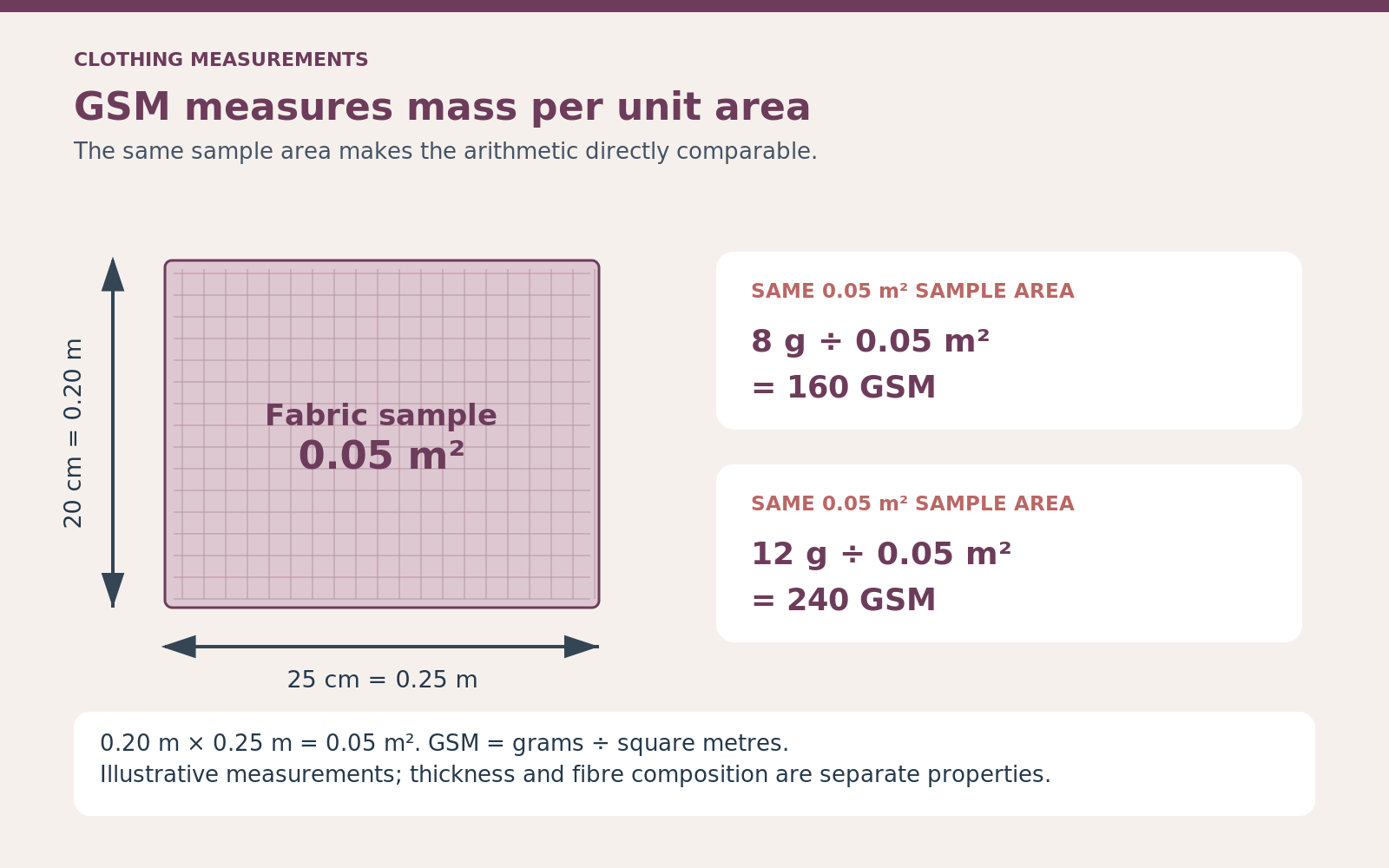
Imagine two rectangular swatches, both 20 centimetres by 25 centimetres. Each covers 500 square centimetres, or 0.05 square metres. If one weighs 8 grams and the other weighs 12 grams, their calculated values are 160 and 240 GSM respectively.
Keep the unit conversion visible
To calculate GSM from a small sample, first express the area in square metres. Divide the sample mass in grams by that area. Do not divide by the length alone, and do not convert centimetres to metres only once when calculating a two-dimensional area.
In the fictional 8-gram example, 8 divided by 0.05 equals 160 grams per square metre. A common arithmetic error is to treat 500 square centimetres as 0.5 square metres, which would produce a value ten times too small.
If the sample dimensions are recorded in millimetres, convert both dimensions consistently. Keeping the intermediate area in the worksheet makes a calculation auditable. A final GSM number without the sample’s mass and dimensions hides mistakes that would otherwise be easy to notice.
If a listing uses ounces, read the denominator carefully. Ounces per square yard is an areal measure, while ounces per linear yard depends on roll width. A unit converter cannot supply a missing width. Preserve the complete unit instead of copying only its number.
Distinguish fabric mass from garment mass
A finished garment contains shaped pieces, seams, labels and sometimes different materials in different sections. Its total mass is therefore not the GSM of its main fabric. Two shirts made from the same fabric can weigh differently because their sizes, sleeve lengths or construction differ.
For a constructed example, 1.2 square metres of a 180-GSM fabric contributes 216 grams before accounting for other components. A larger design using 1.5 square metres contributes 270 grams from that fabric. The material’s GSM remains 180 in both calculations.
Do not reverse that calculation using a garment’s shipping weight. Packaging and accessories can be included, and the area of fabric used is usually unknown. A scale reading can compare complete items, but it cannot recover missing construction information by itself.
Read fibre percentages as composition information
A label stating 60% cotton and 40% polyester describes a composition by fibre weight in the relevant labelled material. It does not say that 60% of the visible surface is cotton or that the fabric has a particular GSM.
The FTC’s Textile Fiber Rule overview identifies fibre names and percentages by weight as label information for covered products. This is a different measurement from mass per unit area, so the two belong in separate columns when comparing garments.
Two fabrics can have the same fibre percentages and different GSM values. Conversely, fabrics made from different fibres can share the same GSM. Keeping composition and areal mass independent prevents a label from being used to infer a property it never claimed to measure.
Do not substitute GSM for thickness
Thickness concerns the distance between surfaces under a stated measurement procedure. A lofted material can enclose more air than a compact material. That makes it possible for two fabrics with similar areal mass to have noticeably different thicknesses and compressibility.
Consider two fictional samples with equal area and equal mass. One is loosely structured and bulky; the other is tightly packed. Nothing in the equality of their mass requires equality of their thickness. The difference becomes especially apparent when a measuring foot compresses one sample more than the other.
For a useful comparison, ask whether thickness was measured under the same contact pressure. An informal calliper reading and a standard laboratory result may not be directly comparable. Reporting the method is particularly valuable when the material changes shape easily.
Use a comparison sheet with independent fields
A practical sheet can contain fabric composition, GSM, construction, measured thickness, garment size and care instructions. Leave unknown fields blank rather than filling them with assumptions. A missing value is information about what the listing does not tell you.
Then connect each field to the decision it actually supports. GSM helps describe material mass over area. Garment measurements help assess fit. Care instructions describe handling requirements. Neither a fibre name nor a GSM value alone establishes how the item will feel against skin during a long day.
If you have samples, compare them under similar conditions and record observations separately from numeric claims. “Feels stiffer when folded” is a useful observation, but it should not be relabelled as a measured stiffness value without an appropriate test.
Account for sample condition and variation
Moisture, finishes and variation across a textile can affect comparisons. A laboratory may specify conditioning before measurement. A home swatch weighed immediately after handling or storage should not be described as though it automatically follows that procedure.
Repeating a measurement on several pieces can reveal whether the first sample was unusual, but it does not turn a household test into product certification. Keep the purpose modest: checking a calculation, comparing available samples or identifying a question to ask the supplier.
This habit of naming each measured property becomes useful beyond clothing. Materials that contact skin, including experimental peptide-based surfaces, also need separate descriptions of composition, structure and physical behaviour. One headline number can orient the reader; it cannot replace those distinctions.


